|
Soldier On! w/Leroy Garrett — Occasional Essays |
|
Essay 173 (5-5-07) KEEPING IN TOUCH (2)
You will
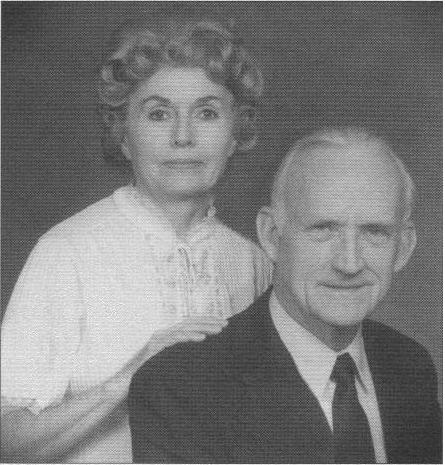
forgive me for including a picture of Ouida and me with this essay. I have
long supposed that it is just as well that editors be read but not seen,
There is especially good news about Ouida. She has been able of late to be out and about.. She walks a hundred yards or more outside each day. And she has attended the assembly of the saints the last three weeks. Last Sunday she joined me -- along with Bill and Linda Fox who drove us -- for a 75-mile round trip to Irving where I addressed the Plymouth Park Church of Christ. We afterwards dined in the home of Tom and Lucy Fullerton, longtime friends with whom we made a trip last year to New Mexico to see the balloon festival in Albuquerque and to visit Ouida’s sister in Gallup. While Ouida did all this with both grace and resolve, she is not yet fully recovered. But it cheers her friends and delights her husband when she makes the special effort to show up. I addressed the congregation twice -- on the genius of Stone-Campbell plea at the study hour and on the transforming friendship in the assembly. I told them that the genius of our plea from the beginning was that the union of Christians could be effected on the basis of the facts of the gospel (the essentials), while allowing for liberty of opinion, theories, ad theology about those facts. This plea gave rise to a motto that well defines the essence of the plea: “In essentials unity, in opinions (and methods) liberty, in all things love.” On the transforming friendship, I told them of the Friend who had transformed my own life -- from ignorance and foolishness to an ongoing search for truth and integrity, from legalism to freedom in Christ, from sectarianism to a desire for the unity of all God’s people. This Friend has made me more sensitive to suffering humanity, and more grateful for all the goodness in the world, He has made me a better husband, a better neighbor, a better friend to others. That Friend stands at the door and knocks (Rev. 3:20). It is not the door of a brothel, or of a pagan temple, or even of the United Nations. It is the door of his own church! This Friend is a gentleman; he doesn’t barge in nor impose himself. “If anyone hears my voice and opens the door. I will come in to him and dine with him, and he with me.” It is an invitation to intimate fellowship with Christ himself. But one must open the door and invite him in. The Friend isn’t saying that he will engage in table-talk, as if to solve one’s problems. He may say nothing at all. He is rather the very present Friend, even if silent, who is there for us, and his presence has a healing and transforming effect. If he says anything at all, he might ask a troubled soul, “Would you like to tell me about it?” Since Carl Ketcherside had ministered to that congregation now and again through the years I told them the story of his response to the “Knock at the Door” when he was in Belfast, Ireland back in the 1950s. At that time he was the “wing commander” -- to use his term -- of a particular Church of Christ sect, and its premier editor and chief debater. He had been preaching since a boy and had baptized thousands. But he had never invited Jesus into his heart. Alone on a wintry night in a small frame building named “Church of Christ” in Belfast, Carl, now fed up with the sectarianism that had controlled his life, got on his knees and laid claim to the promise of Rev. 3:20. He responded to the “knock at the door” and invited Jesus to enter in and rule over his heart and life. It proved to be a transforming friendship. He resolved then and there that he would never be sectarian again, and he went on to become an impressive advocate for the unity of all believers, beginning with his own people. Some people may be able to accept Jesus as a friend who are not yet ready to accept him as Lord and Savior. Theology confuses them, but they see a special kind of person, one they would welcome as a friend, in the way Jesus treated the poor woman caught in adultery. While cruel and judgmental authorities would have her stoned to death, Jesus treated her kindly and did not condemn her. Jesus even told his disciples that he would no longer call them servants -- as honorific as that was -- but “I will call you friends” (John 15:15). A transforming friendship. The Vintage, a retirement facility here in Denton, has informed us that a first-floor (premium and more expensive) one-bedroom apartment (625 square feet) will be ready for us in a few weeks. This will position us for a larger apartment later if we opt for one. We plan to go ahead and make the move, and then continue preparing our home for the market. Though we’re making progress, we still have much to do. In going through my books I have turned up several bound volumes of Restoration Review (two years in each volume) that I didn’t realize I had, and yet through the years we’ve had numerous requests for them. But I didn’t keep the names. These I will sell. If you are interested call me at 940-891-0494 and I‘ll explain what we have. |