WE'RE 25 YEARS OLD!
In the history of our Movement we've had literally thousands of journals sent forth from the press. Printer's ink has flowed in the veins of our leaders, as the historians like to put it. Most of these papers survived only a few years and many of them only a few issues. Only a very few indeed have prevailed for a quarter of a century, and fewer still have gone that long with the same editor. While there is no particular virtue in mere survival, we pause after these 25 years to thank God that He has given us the strength and the wherewithal to hang in for so long.
It is probable that most of our readers have never even seen a copy of old Bible Talk, which is what we were called for the first six years, beginning in October, 1952. Artist Tom Farr, a brother in our congregation here in Denton, has come up with a creation that will give you an idea what we first looked like. The first issue was soon in short supply, and all the 64 issues of Bible Talk have long since been unattainable, though we continue to get requests for them. We published all 12 months for the first two years, reserving the July and August issues for evangelistic purposes. In October 1954 we went on a schedule of ten issues a year, skipping July and August, which has been our plan ever since, except that the first five years of Restoration Review were issued on a quarterly basis.
Our very first paragraph to be presented to the public was a statement of purpose:
Simply stated, our purpose in this paper is to do all the good we can and no harm at all. We may not succeed in such a purpose but we shall try. The mission of this new paper is primarily to the church. We feel that the church faces grave dangers, and these dangers must be faced if the church is to triumph. "Bible Talk" does not pose as a reformer of the church. Neither does it claim to know all the answers or to be a panacea for all our ills. It only wants to help in some small way in the battle that is obviously before us. It has something to say and its only request is that it might be given a fair hearing.
 |
|
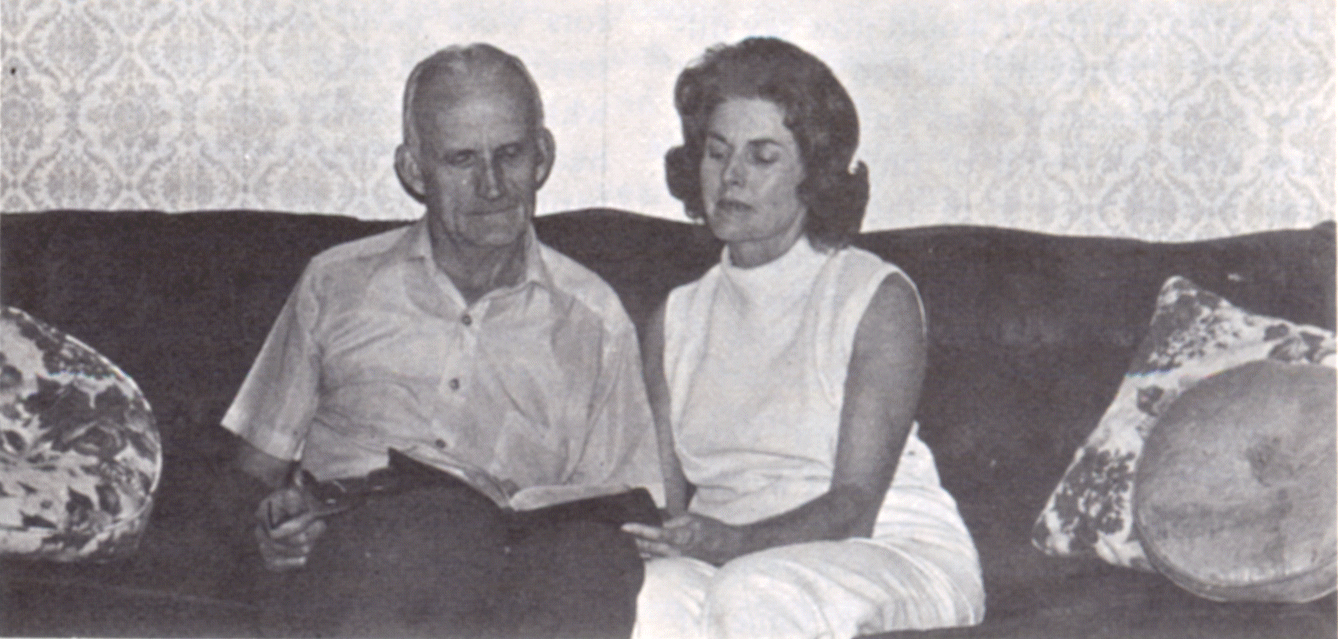
This gives you some idea what we look like. From our house to yours, with love. — Ouida and Leroy |
In that editorial I identified some of the problems. "The church needs more personal study and more private prayer. It needs more piety and consecration," I observed, and I further made it clear that I was going to fight our entrenched pastor system: "That we have a pastor system is generally conceded even by the more liberal element. The college president to whom we have referred said in his lecture about our dangers; 'There is a tendency toward the pastor system.' And in repeating that speech on one occasion he left his manuscript to add: 'And I apologize for the word tendency!' This paper will not shun a full treatment of all such subjects, whether they he tendencies or actualities." I zeroed in on what I conceived to be the real culprits: "We feel that institutionalism and professionalism are teammates in that inauspicious game of apostasy into which they have together enticed the church. The bride of Christ is being escorted into religious prostitution with professionals on one arm and institutions on the other."
But there is one statement in that first editorial that I would now say differently: "Mankind has had the gospel for two thousand years and yet today less than one-tenth of one percent of the human race is in the church of Christ." While the light had begun to break even then, I was still something of an exclusivist about the Church of Christ.
Well, as the months and years slipped by we were accused of writing on nothing except the pastor system, which was hardly the case. As I look back on those years I think some of my very best writing, on many different themes, were in those early volumes. Some of it was written at Harvard, while I was finishing my Ph.D. in the history and philosophy of religion, so I had the stimulation of that very unique environment. I met one student there, a mature woman, who had fled from behind the Iron Curtain. We told her story, without revealing her name for her own protection, in two installments, the kind of material that might have appeared in something like Readers' Digest.
My "Letters from Harvard" dealt with my experience of dining at the Graduate School with students from all over the world, or about my visit to a Quaker meeting in Cambridge, or about my visit with an Episcopal priest (also a Ph.D. candidate) at his humble abode where he lived on $5.00 a week, or about my preaching at Boston Common where I immersed a man into Christ one wintry evening. I spent five months away from home at Harvard in 1956, writing my thesis. Ouida and our newly-adopted Phoebe were in Dallas. So the paper for that year reflects that experience, including a siege in the Harvard infirmary, where doctors were never able to diagnose the severe pains that wracked my back, which I had never had before or have had since. When I told one of Harvard's top surgeons that a friend had written that perhaps I was too anxious about getting my work done and was suffering "anticipatory anxiety," he asked me to repeat that term. He playfully rejoined, repeating that weighty term, "Maybe that's it!"
I finally got tired of the infirmary and asked my doctor to let me out, pain or no pain. I went back to the library, to the one spot that I hallowed with hundreds of hours of hard work, and wrote my thesis, holding my left shoulder with my right hand and writing with my left hand—which is the hand I write with anyhow! I conned the janitor of the library into letting me in when he came to work, long before the library opened, and the student workers would allow me to stay on after they closed the doors late at night. After months of that I earned the reputation from my major professor for being "the most industrious student" he had ever seen. It was my industry that impressed him more than my intelligence! What he didn't know was that I was No. 2 and was therefore trying harder. I was out to prove that a high school dropout could take a Ph.D. from Harvard, and I am probably the only one who ever did. Too, Ouida was back home, so I was in a hurry.
I was determined to finish my thesis that spring, so I presumptuously filed a request for the Ph.D. for Commencement that year. Prof. Amos Wilder, both sympathetic and amazed, rebuked me with "You can't do that. No one has ever done a thesis that quickly." I was adamant. As they became more demanding, I worked all the harder. They would turn my chapters back to me with all sorts of suggestions for further research, and I would turn them back to them with all that they asked for and more. I hired an expert linguist to help me with difficult theological French and German passages, and called on him at all hours of the day and night. The deadline came and I didn't make it, to no one's surprise except my own. I went home to Ouida and Phoebe. I went back to Harvard the next year for several more weeks and finished. But I didn't wait around for Commencement, which is one of the most impressive displays of academic pomp in the world. The postman delivered my Ph.D. to me at my front door back in Dallas later that year. Ouida and I laughed about how ingloriously I had received the top degree from one of the world's greatest universities. It was something like getting the utility bill! But, my inferiority complex being what it was or is, it did me a lot of good, even if it did come to me through the screen door.
Anyway, those were Bible Talk years, for along with my thesis I edited the paper. By 1955 I had begun to write on "The Sin of Exclusiveness," in which I said: "We are not to consign all the people to hell who are not identified with us. Neither are we to conclude that there are no Christians in other religious bodies. All who obey the Lord's word belong to the church of Jesus Christ. There may be many who are 'not far from the kingdom of God' who need our encouragement more than our censure. Let us not forget that God does have people in Babylon, and they are his people (Rev. 18:4)." In those days I ran a number of series of studies in church history, growing out of my Harvard studies, such as the early Christians and war and Judaism in the time of Christ.
My favorite article from those early years, if not of my entire editorial career, was the one I did on "Harvard University and Freed-Hardeman College: A Study in Contrasts," in which I said: "Harvard can be moral without being Christian, but FHC cannot be Christian without being moral." I laid bare some facts about both institutions. While blacks were not allowed when I studied at FHC, I learned to study with them at Harvard. I wrote: "When it takes the nation's courts to lead FHC to do what its own recognized principles could not inspire it to do, then its influence is basically immoral."
While I was at Harvard it came under severe attack from "the right" for its liberalism in general and its "harboring of Communists" in particular. Rockefeller had given the university a million dollars and some fellow in the midwest charged that it was a waste of money, and he issued a long document discrediting Harvard on several counts. What was impressive about all this was that I read all these charges on the Harvard bulletin board in the Yard. The officials were quite open to any charges anyone wished to make, and they had no qualms about passing them along for the students to read and to decide for themselves. That's freedom!
In drawing a contrast with this kind of openness, I told how FHC cringes in the face of criticism, as most of our colleges are inclined to do, and squelches any dissident voice, if it can, even to the point of putting its own people in jail. I spoke with authority on that score, for I was the one they put in jail! That episode, which I described in detail in the Feb., 1955 issue of Bible Talk, proved to be one of the most explosive incidents in our entire history as a people. Virtually every paper among us had something to say about it. Only Ketcherside's Mission Messenger, in its lead article, Leroy Garrett Jailed!, took issue with what FHC had done, though Jimmy Lovell's paper in California described it as "the most shameful event" in our recent history. The Guardian wrote on "The Ins and Outs of Leroy Garrett" and the Gospel Advocate had several articles designed to patch up what FHC had done, including the charge that "We cannot believe he is a normal man." They had one article signed by 26 preachers, exonerating the FHC authorities for throwing me in the cooler for the night.
In the meantime I was weighing the question in my editorials a: to whether I should sue FHC for false arrest, armed as I was with their dismissal of the charge of disturbing the peace. I challenged them to make it clear as to whether they were really a private institution, as they claimed, in which case I would sue them and take over a dormitory for damages, if need be; or whether they were actually a church institution, as I claimed, in which case I wouldn't sue them since I didn't believe in suing the church!
In those days I was the most controversial figure among us, and I was the issue in several of the papers. I made front page copy in the Gospel Advocate for weeks on end. You can see that with all my popularity these days I have wonderfully improved my standing!
It was just as well that I had long since decided that I could never expect to be supported financially by our people, nor did I want to be in that situation. Before Harvard days I taught in high schools. My Harvard degree was my union card into the world of academe. I started teaching in college in 1957 and have continued in that work since that time, though in recent years it has been only on part-time basis, other business interests making this possible. After all, the very first cover of Bible Talks had these words from Alexander Campbell: "It is a rarity, seldom to be witnessed, to see a person boldly opposing either the doctrinal errors or the unscriptural measures of a people with whom he has identified himself, and to whom he looks for approbation and support. If such a person appears in any party, he soon falls under the frowns of those who either think themselves wiser than the approver, or would wish so to appear." So Campbell had sufficiently warned me!
But the issue of Bible Talk was the one-man hired minister system, which I turned every way but loose. Surely in all our history, except perhaps with Campbell himself, has the clergy system within any one party received such a persistent and devastating attack as it did in Bible Talk. I defined it, exposed it, answered questions about it, gave examples of it, debated it—the works. I even hired an artist to caricature it! I spent much time on the scriptural function of elders and the work of the evangelist, showing that "the minister" is doing what the elders and others should be doing. I called upon our pioneers, as well as the Bible, to show that it was never intended that we have such a system.
The older preachers, a lot of them, still haven't forgiven me for those thunderous years. Nor have I asked them to! If anything, I believe now what I wrote then even more than I did then. My methods may have changed some, and certainly I have learned to be more loving and forbearing in the face of problems that have long been with us. Especially have I come to see that all such issues must be dealt with within a loving fellowship and not in a spirit of agitation. But as I look hack over those years I see that I was, for the most part, reasonable, moderate and loving. But I did press the issue. I would not let up. And, believe me, there is no way, but no way, to fight clericalism in the church and not come upon hard times.
It is interesting the difference that the years make. In more recent years I've had even some of the older preachers to tell me how right I was in my fight against the system back in Bible Talk days. I'm always tempted to say that I could surely have used their help then! And many of the younger preachers confide in me their desire to free themselves of the clerical trap. I advise such ones to be multi-disciplined men who are able to support themselves apart from the church treasury, if need by. More and more of our men are doing this. More important, we have a growing number of free churches that make it possible for preachers to work with them without having to practice the system.
Our own congregation here in Denton is an example of what I mean. It does precisely what I pled for year after year in Bible Talk—a free, spiritual, sharing ministry in which all who have the gift of teaching and exhorting can do so, led by their elders who also minister to the congregation, and if the church chooses to employ a man (or woman!), let it be under such circumstances that do not circumvent the scriptural norm: "As each has received a gift, employ it for one another, as good stewards of God's varied grace" (1 Pet. 4:10).
The Lord has really surprised me on this score—far more than I could "ask or think." Here is this free congregation right here in Denton, made up of people who never heard of Bible Talk, practicing what I labored so hard for many years ago. And it is happening all around. It is when churches become free that makes the difference. When they become free, they dump the system, more or less. The system is not only a one-man domination of the pulpit, but the arrogant and brutal tactics of sectarianism and exclusiveness that make impossible a free and loving fellowship of all. believers.
So, since Bible Talk days I have come to see our problems in broader perspective. The culprit is carnality in all its varied forms. The antidote is freedom in Christ—the freedom to unite with all God's people, to love, to question, to minister, to be a little different, to be the functioning Body of Christ. No clerical system, no system of obscurantism and partyism, can survive in the face of such freedom.
This remains our task. We called ourselves Restoration Review starting in 1959. This is our 158th issue since the change of name. Our operation is really sort of low key. The paper stays alive and in reasonable health--I was intending to tell you why, but I really don't know, unless it is that we look to the Lord to bless it as our ministry toward a more loving, spiritual and responsible church. We are enjoying being a part of the great victory that has come to us all thus far. The future? I am sure that our labor will not be in vain. How much longer will we publish? It would he inappropriate to have any other view than "One issue at a time, dear Savior."
I am using our and we so as to include Ouida and not simply as the editorial plural. She has yet to write her first article and has no plans of getting around to it, which means that her mistakes in these columns all these years have been far fewer than my own. But I've read hundreds of articles to her across the kitchen table—and it would make interesting reading if you had access to what she persuaded me to delete. For good or ill, I do not always listen to her, but I do more than I don't. I sometimes insist, "If I expect to really change people's thinking, I have to lay it out there like it is." But who really knows what to write and how to write to the modern church with its many sticky problems? These days I find myself praying more about each article that I am about to compose, and I don't think I've always done that. I often feel very inadequate for the task. Who really knows how to be an editor?
But one thing I know and that is the worth of Ouida by my side. She is my crown and joy. We are fellow laborers in the Lord for your sake. We hope to arrange for a picture for this our 25th Anniversary Issue, so that you can see what we look like in our element. This is our way of sending special greetings to you all. — the Ed.
__________________________________________
THE CHURCH OF TOMORROW
The church of tomorrow will be much less denominational. While it may keep the denomination as a method of getting work done, it will transcend utterly the notion of any denominational self-sufficiency.
The church of tomorrow will he one in which the local church is a small theological seminary. It will be a place where what we have called laymen will learn and study and prepare for their witness in the world. The week days will be more important than Sundays. — Elton Trueblood
Let a man discover what he is characteristically touchy about and he will gain valuable insight into his personal problem. — Harry Emerson Fosdick