No. 60, July 2003
WAS JESUS RELIGIOUS?
It may come as a surprise to most people that religion does
not fare well in the Bible. It is not mentioned at all in the Old Testament. No
prophet ever calls people to religion or to be religious, and no psalmist extols
religion as such. While the word religion
or religious appears five times
in the New Testament (KJV), there is only one instance where it is treated
favorably. Even in that passage James
1 “pure and undefiled religion” (v.
27) is contrasted with “useless religion” (v. 26). The other instances refer to
either Jewish religion (Acts 25:19; 26:5) or the “very religious” Athenians
(Acts 17:22), which some versions render “superstitious.”
It is noteworthy that while Paul referred to his life as a Pharisee
as “the strictest sect of our religion,” he never refers to his faith in Christ
as religion. While he at least once referred to pagans as religious, he never
describes Christians that way. No writer of the New Testament even hints of
Jesus introducing a new religion.
This may be because religion is usually seen in terms of
dogmas, systems, priestly sacrifices, altars
with emphasis on outward forms, often to the neglect of the heart. Jesus
showed an adamant indifference to all such
including fasting and the sabbath, which were part of the law of Moses.
He in fact exposed the religion of the Jewish clergy as “you travel land and
sea to win one proselyte, and when he is won, you make him twice as much a son
of hell as yourselves” (Mt. 23:15).
Our Lord used “righteous” and “righteousness” where others
might use religion. “Except your righteousness
exceed the righteousness of the
scribes and Pharisees. . . (Mt. 5:20). “Seek first the kingdom of God and his righteousness. . (Mt. 6:33). Jesus urged
that we seek righteousness, not religion.
That is a vital distinction
righteousness rather than religion. Jesus defined righteousness at his
baptism. When John was reluctant to baptize him, he said, “Permit it to be so
now, for thus it is fitting for us to fulfill all righteousness.” Righteousness
is the heart’s resolve to do God’s will.
Jesus pointedly drew the distinction in the story of the tax
collector and the Pharisee in Luke 18. The Pharisee was religious he fasted, tithed, and was not a sinner like
other men, including the despised tax collector. The tax collector did not
presume even to approach the altar, nor to lift his eyes toward heaven. He
stood afar off, and smote his breast, saying, “God, be merciful to me a
sinner.” Jesus said it was the tax collector who was righteous. It was the
other guy who was religious religious
but not righteous.
It is a sobering distinction. I sometimes think of it as I “go
to church” a very religious thing as
the world sees religion. I join others in such forms as praise, prayer, alms,
and breaking of bread. Religion! But am I righteous in what I do?
Jesus must have been thinking this way when he taught that
relationships are more important than ritual, as in Mt. 5:23-24 when he said,
“If you bring your gift to the altar, and remember that your brother has
something against you, leave your gift there before the altar, and go your way.
First be reconciled to your brother, and then come and offer your gift.”
Reconciliation before religion!
Billy Sunday, the great evangelist, had a way of slapping his
knee with his Bible and crying out, “Don’t forget that it was religion that
killed Jesus!” He would never have said that righteousness killed Jesus. That may be what is “killing” the
church today and confusing the world
religion. It is righteousness that exalts a nation or a church not religion.
We live in a world where there is much religion whether in Iraq, Iran, Saudi Arabia,
Afghanistan, Russia and it is often
practiced with fanatical devotion. But where is the righteousness hearts devoted to doing God’s will love for God and love for neighbor?
Jesus was righteous (Acts 3:14), but was he religious? Look at
the crowd he ran with! Many of us in the church today are religious. Look at
the crowd we run with! But are we righteous?
Leroy
A FAREWELL TOUCH
(Last essay after 51 years)
Even though several prophets were touched by angels, Daniel is
unique in being touched thrice, all in one episode. In chapter 10 of the book
that bears his name he is depicted as overwhelmed by the visions that unfolded
before him. He “lost his strength” and his “vigor was turned to frailty.” An
angelic visitation finds him in a deep sleep with his face to the ground. He
was suffering from too much revelation
apocalyptic revelation!
Then came an angel’s first touch, but this compounded his
anxiety. His knees knocked together and his hands trembled. The angel spoke
tenderly, assuring the prophet that God loved him “Stand upright,” the angel
told him, “for God has sent me to you.” Daniel managed to stand upright before
the angel, but he stood there trembling and speechless.
The angel tells him not to be afraid, for he had come in
response to his prayer to God. The prophet had prayed for an answer as to what
was going to happen to his people then suffering persecution. The angel was
soon to reveal what was to happen to God’s chosen people over the next four
centuries, which is outlined in chapter 11.
The second touch was on Daniel’s lips, enabling him to speak.
He explains to the angel that he is something of a basket case, that because of
the vision “my sorrows have overwhelmed me, and I have retained no strength.”
He wants to know how he can be expected to stand there and converse with an
angel from heaven!
We can all identify with Daniel’s problem. Not many of us
could all that easily stand in the gap and carry on a conversation with an
angel!
Then came the third touch
and it was as beautiful and it was brief. The prophet simply says, “Then
one having the likeness of a man touched me and strengthened me.” The angel
again speaks of God’s love for him, and tells him not to fear, but to be
strong.
Daniel touched by an
angel the third time was now ready to
hear the breathtaking revelation about the future. “Speak,” the prophet tells
him, “for you have strengthened me.”
I come away from this story with a concept that will not let
me go the language of touch.
The great poets knew the
language of touch. Shakespeare has Romeo say of Juliet: “See! How she leans her
cheek upon her hand; O! that I were a glove upon that hand, That I might touch
that cheek.” And Tennyson laments a lost love one: “But O for the touch of a
vanish’d hand, and the sound of a voice that is still.”
Our Lord had a touching ministry.
He touched eyes that were blind, ears that were deaf, and tongues that could
not speak. He healed by touching. When he was called to the bedside of Peter’s
sick mother-in-law, “He touched her hand and the fever left her” (Mt. 8:15).
Little children were brought to him “that He might touch them” (Mk. 10:13.). He
even touched despised lepers, and they were made whole (Mt. 8:3).
Not only did Jesus touch so as to heal and comfort, but he allowed himself to be touched by those who sought healing. The desperate woman with a flow of blood resolved that “If only I may touch His garment, I shall be made well” (Mt. 9:21). He was sometimes surrounded by a crowd of sick people, begging that “they might only touch the hem of his garment. And as many as touched it were made perfectly well” (Mt. 14:36).

The language of touch may speak louder than words. I’ve
experienced this in my many visits to nursing homes. Often I would do little
more than hold the hand of one who had long since given up all hope. When words
seem inappropriate, a loving embrace of a friend immersed in grief can be
wonderfully consoling. We do well to stoop down and touch a child who may feel
left out in the company of adults. It is a language that a child understands.
But we must be careful about a hands-on touch, for some people
don’t want to be touched, and that’s OK. There are other ways of touching an encouraging word, a kindly note, a
thoughtful phone call, or by simply being there for them. It is the same
language. Ouida tells the story of a friend who called on her mother shortly
after Ouida’s father died of a heart attack while helping a man who had been
shot in a hunting accident. The old friend did not say a word, and he did not
physically touch her. He simply sat with her as if the grief were his own.
Ouida’s mother often referred to that visit as the most consoling during that
grievous time.
Lest we forget, there is a language that reaches beyond words.
It is the language of touch applied in
different ways.
I want to believe that this is what I’ve been up to the past
half century in my writings. Not words only, but words in the language of
touch, and that means to write from the heart to the heart. I’ve sought to
challenge you to think, to entertain new ideas, to question old dogmas, and to
encourage you to hang in and not give up, for help is on the way. I’ve sought
to lead you to “Entertain foreign states of mind,” to quote William James.
Above all, I’ve urged you to stake out your claim for freedom in Christ.
My farewell touch will be when for the last time I apply the address label to your copy of this newsletter that has your name on it. That is my job. Ouida
prints the labels from the computer and I apply them to the newsletter, all
2,078 of them. As I apply your label touch
your name I will pray for you that you
will grow in Christlikeness, right on into eternity.
That may not be like being touched by an angel, but it is my
way of saying Farewell and
Soldier on.
As Ouida and I walk on into
the sunset of life we covet your prayers as well your touch on us and
the same prayer will do, that we too might grow to be more and more like Christ,
right into eternity. That is what all this has been about all these years, the
pursuit of Christlikeness. Leroy
OUIDA’S FAREWELL
How do I say goodbye to old friends after over a half a
century? We are old friends even
though most of us have never met
because I see your names so often on our mailing list I even know the
handwriting of many of you by way of your letters, book orders, and
subscription renewals through the years. We have shared many ideas and have
witnessed many changes, not only in the world but in the church as. well.
We have seen mind-boggling change in our personal lives. When
we mailed the first issue of Bible Talk in
October of 1952 little did we realize what was in store for us. A force was set
in motion that we could not have predicted. My free thinking husband had a
lover’s quarrel with the church, and he set about to help it make some
important changes. We take heart that some of these have been at least partly
realized.
But not without opposition. Soon after our first issue
appeared, one prominent editor Yater
Tant in the Gospel Guardian predicted that our little paper would suffer
an early demise, and that an appropriate epitaph would be Opened by mistake! It was a long time before it got better than
that It took some getting used to, but some of it I never got used to such as when Leroy called from Tennessee to
tell me the brethren had put him in jail!
We started out with manual
hand-stamped equipment After a
few years we progressed to electrical equipment, and finally to a computer. We
sorted our first issue by spreading it out on the floor, arranging it by
states. In time mailing became more complicated. The post office began to
require that we sort by zip code, then by the first three digits, and then by
the area distribution center. The mailing of that first issue cost only a few
dollars, but the cost has so escalated through the years that it now rivals the
cost of printing.
Leroy decided from the beginning that he would not ask for
money. If the publication could not sustain itself, we would let it die. The
one dollar subscription cost of the paper
and finally five dollars could not possibly cover the cost, but there
were enough people who believed in what we were doing that they sent
donations large and small. Book sales
helped some. When Leroy received an honorarium for speaking it went toward the
publication of the paper. True to his decision, he never asked for money, but
we always met our obligations. The Lord provides!
My responsibilities have been to keep up the subscription
list, address the labels, sort them for the post office, keep the books, and
pay the bills. I will not shed a tear when all of that comes to an end! Leroy’s
responsibilities have been awesome. He taught full time all those years and was
obliged to write a twenty-page journal each month ten times each year.
Even though it has been an arduous task, I would not have missed it My mother was right when she said before we were married, “If you marry Leroy you will not die from boredom excitement maybe but not boredom!” Ouida
That this is our last issue does not have to mean a final
goodbye. We can stay in touch. You may still write or call. You may still order
books. You may even be coming our way and can drop by for a visit. Denton is on
the way to a lot of places. We can also keep in touch in cyberspace. Starting
in September I plan to write an article each week similar to those that have appeared in this newsletter and send it e-mail to those who request it,
and only to those who request it. If you wish to be included, send your request
to us at leroy.ouida@worldnet.att.net
We still do not have an exact date from the ACU Press as to
when A Lover’s Quarrel: My Pilgrimage of
Freedom in Churches of Christ by Leroy Garrett will be published. But if
you have ordered the book, it will be sent to you when published, with the
invoice enclosed and at 20% discount off the list price, which itself should be
moderate. You may still order the book
at 20% discount in one of three
ways: by writing to us e-mail, by regular mail, or by calling us at
940-891-0494. You may order multiple copies at the same 20% discount. While it
will be something of a task since we
already have almost 500 orders I plan
to autograph each book. We have had so many requests for an autographed copy
that I’ve decided to do them all. Ouida thought I might have a signature stamp
made like banks and famous people
sometimes use. No stamp. It will be an authentic signature.
Ouida insists that I urge this upon you: If in the meantime before the
book is published you have a change of address, please inform
us of your new address.
In recent newsletters we’ve
given you portions of the book the
Introduction and two addenda. In this issue we give you three of the twenty-one
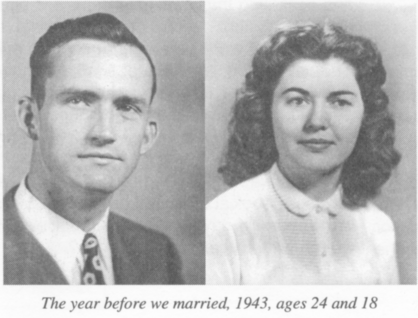
pictures that appear in the book. But the pictures are more than that in this
newsletter. They are part of our farewell to you an expression of our appreciation for your putting up with us
all these years. Beside, I want you to see how lovely Ouida was when I first
found her, and for those who have not
yet met her to see how lovely she
still is, a beauty reflected in her soul as well.
It took some effort on my part to get Ouida to write a
farewell note to our many readers who have come to love her, having never seen
her. She did not want to say goodbye, or didn’t know how to say it. So I told
her to say farewell without saying farewell! You’ll want to read what she came
up with.
We are all together walking toward God’s tomorrow just at different points along the way.
I rejoice that I have lived to see greater interest in
studying our own history. ACU Press has recently published two titles that we
recommend: Renewing God’s People: A
Concise History of Churches of Christ by Gary Holloway and Douglas Foster.
$16 postpaid;
Recovering A Heritage:
Reflections on the Heart, Soul and Future of Churches of Christ by Richard
Hughes, $16 postpaid. These titles
mainly about Churches of Christ
go well with The Stone-Campbell
Movement by Leroy Garrett, which treats the movement as a whole. $35
postpaid.
We are indebted to Leonard Allen and his Leafwood Publishers
for high caliber books especially for Churches of Christ. We told you in our
last about The Jesus Proposal by
Rubel Shelly and John York, a book about Christian unity that both informs and
inspires. $20 postpaid. Sundays with
Scottie by Milton Jones is about what a minister learned from one of his
members with cerebral palsy a
warm-hearted book that would be an ideal gift. $11 postpaid. Down in the River to Pray by John Mark
Hicks and Greg Taylor is a significant re-evaluation of how baptism should be
viewed in Churches of Christ. $16 postpaid. Come
to the Table by John Mark Hicks is a groundbreaking study of how we should
view the Lord’s supper. $14 postpaid.
It is well these days to know about the Muslim faith. Christ and Islam: Understanding the Faith of
the Muslims gets to the heart of it. $6.00 postpaid.
We can still provide The
Twisted Scriptures by Carl Ketcherside for $9.00 postpaid, and Our Heritage in Unity and Fellowship by
Carl Ketcherside and Leroy Garrett for $12.00
We are virtually giving away the back issues of Restoration Review that we still have on
our shelves one copy of each (as many
as 15 or so) for only $5.00.
